



Why did Michael Jackson want to invent new sounds?

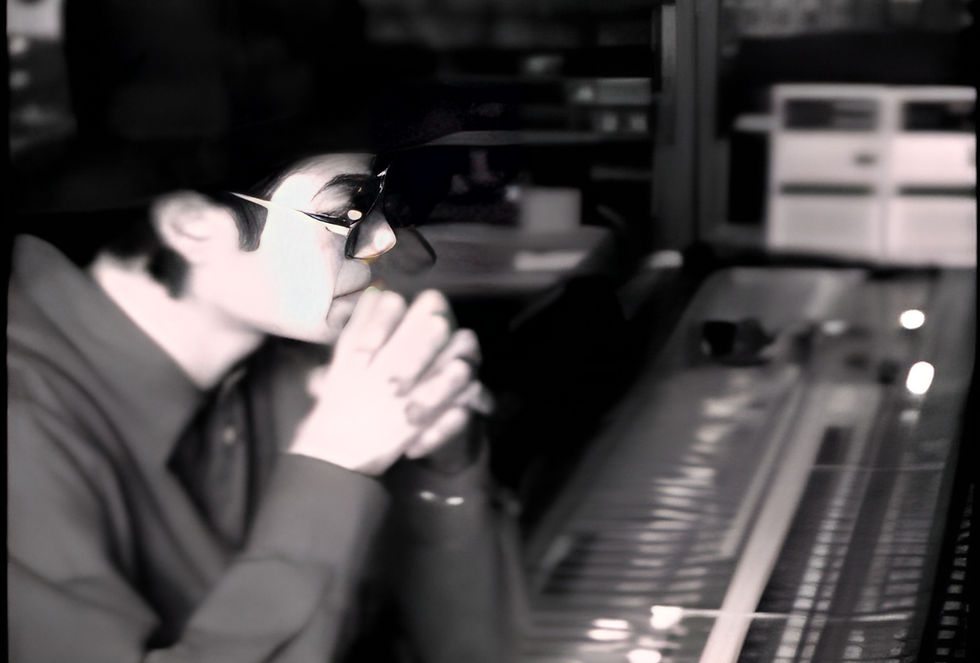
There are phrases that, on their own, illuminate an entire artistic approach.
When Michael Jackson asked Chuck Wild in 1994 to create " sounds the human ear has never heard ," sounds that were " explosive, aggressive, unusual, and unique ," the phrase might initially appear to be yet another manifestation of the perfectionism often attributed to him. However, it undoubtedly says much more.
Because this quest doesn't seem to simply reflect a desire for innovation. It reveals a very unique way of thinking about sound.
Listening to his work and reading the accounts of his collaborators, one thing gradually becomes clear: for Michael Jackson, sounds are almost never simply production elements intended to enhance a song. They establish an atmosphere, suggest a space, foreshadow tension, sometimes even a narrative, before the lyrics take center stage.
As if, in his home, the sound was already beginning to tell the story.
Sound, a surprisingly understudied angle
Among the scientific works and musical writings devoted to Michael Jackson, there is one aspect that seems to me to have been much less explored: his way of thinking about sound itself. Not the notes. Not the harmonies. But SONIC MATTER .
What is sound matter? It is what we call timbre , or, as you prefer and by analogy: its texture, or its color, or even its thickness. And then, above all: its capacity to produce meaning .
This distinction may seem subtle. Yet, it profoundly changes the way we listen to his work. Indeed, sound is not merely what makes a song pleasant or spectacular. It can also shape our perception , create anticipation, evoke emotion , or give coherence to an entire musical universe.
One might then wonder if, in Michael Jackson's case, sound fulfills an even more ambitious function… And that is perhaps where Chuck Wild 's testimonies become particularly valuable.
Michael Jackson did not delegate the sonic universe of his songs

Chuck Wild, keyboardist for the band Missing Persons and a sound design specialist, was introduced to Michael Jackson by Bruce Swedien and Matt Forger . His mission was unusual: to create a vast library of original sounds that the artist could draw upon for his various projects.
What's truly remarkable, however, isn't so much the commission itself, but rather the way it was carried out. Chuck Wild didn't work alone before delivering a finished product. The sounds he envisioned were regularly submitted to Michael Jackson, who listened to them, compared them, selected them, had them modified, or discarded them. The chosen elements then went to the producers and musicians tasked with integrating them into the songs.
This way of working reveals a side of Michael Jackson that is rarely discussed. We know him as a performer, composer, dancer, and director. But these accounts also reveal an artist who meticulously oversees the sonic landscape of his work.
Gradually, it becomes clear that what guides Michael Jackson is not so much the search for novelty as the pursuit of an intimate coherence between sound and musical intention . Each sonic texture thus seems chosen less to surprise than to integrate precisely into the universe it helps to construct.
The difference is significant: a new sound surprises. A sound that is just right already gives meaning.
The whole world as sound matter
This way of working also invites us to move beyond a commonly held idea: that of Michael Jackson being primarily fascinated by new technologies.
It's true that the 1980s and 1990s marked a real revolution in the field of recording. Synthesizers gained power, samplers opened up unprecedented possibilities, and digital processing made it possible to transform almost any sound. Yet, Chuck Wild 's accounts show that the artist never limited his exploration to these tools alone.

The unique, not to say unheard-of, sounds he seeks arise from both machines and the world around him. Engines, elevators, everyday objects, natural elements, or even animal roars recorded at Neverland with Matt Forger : everything seems to be able to nourish his sonic imagination.
What is striking, ultimately, is the lack of hierarchy between these different elements . The sound of an instrument seems no more legitimate than the noise of a car door, the whisper of the wind, or the rumble of an engine. All seem capable of finding their place in a song, provided they serve the artistic intent .
It then becomes clear that technology is never an end in itself . It is simply one means among others of shaping a sonic universe. Michael Jackson's true material may not have been the synthesizer, but the world itself.
This observation seems essential to me. It suggests that Michael Jackson didn't choose a sound for its origin, but for what it was capable of expressing . The question is no longer whether it's natural, artificial, acoustic, or electronic. It becomes much simpler, and perhaps much more demanding: what can this sound convey?
From this point on, the perspective changes. Michael Jackson's songs cease to appear as a juxtaposition of instruments and sound effects. They become spaces where each timbre, regardless of its origin, is capable of contributing to the same expressive construction.
Unprecedented sounds and a work that defies boundaries
While Michael Jackson didn't prioritize sounds based on their origin, he seemed to proceed in the same way with different forms of artistic expression. His work rarely feels compartmentalized. Music constantly engages in dialogue with dance, the body with image, and image with narrative . Each element appears to extend the others, as if they all participated in the same language.
I became aware of this very early on, at the beginning of my thesis, when I tried to analyze his voice. The exercise proved more complex than expected, precisely because it cannot be reduced to a simple melodic line. In Michael Jackson's voice, it becomes percussion, breath, texture, respiration, exclamation. The famous hiccups , the tongue clicks, or certain vocal attacks don't merely embellish the music: they are already part of it.
The same observation could be made about dance. It doesn't simply accompany the songs; it seems to participate in their composition. Footwork, breathing, bodily tension, and the energy of movement extend the musical discourse as much as they translate it. It then becomes difficult to say where the gesture ends and the music begins.
This way of thinking about creation undoubtedly resonates with certain African-American musical traditions , where the boundaries between music, words, rhythm, body, and movement appear less distinct than in the European classical tradition. It is, of course, important to remain cautious: the influences that permeate Michael Jackson's work are numerous, and it would be reductive to try to attribute them to a single lineage. Yet, this profoundly open conception of artistic expression seems to run through his entire oeuvre with remarkable consistency.
Perhaps this also explains why his songs so often feel visual even before they're filmed . Listening to them, spaces take shape, characters seem to appear, movements are sketched out. As if the sound already carries within it the images that the music video will later reveal.
It was this impression that led me to look at the sounds in his songs differently. Until then, I had considered them as sonic textures, production effects, or ambient elements. Gradually, these labels seemed inadequate. They described their nature, but not their function.
Because these sounds do not simply enrich a production… They already seem to begin to tell a story.
When sound plays a part in the storytelling
Many artists have turned the recording studio into a true sonic laboratory . Musicians like Brian Eno, Peter Gabriel, Kate Bush, Björk, Depeche Mode , and Nine Inch Nails have explored the possibilities offered by new technologies with remarkable creativity and contributed to a profound renewal of the aesthetics of popular music.
Michael Jackson shares with them this fascination for sound . However, his approach seems to follow a slightly different direction.
For many of these artists, sound primarily serves to construct an aesthetic universe. In Michael Jackson's work, it very often seems to assume an additional function. It doesn't simply create an atmosphere; it intervenes in the narrative itself. It announces a situation, suggests a movement, prepares an emotion, or even illuminates the meaning of a song.
Here are a few examples, among many others, and in no particular order, which highlight a different facet of this very unique way of thinking about sound.
A prime example can be found in "Jam ." The song opens with a window shattering. More than just a dramatic effect, this sound seems to establish the song's atmosphere from the outset. Even before Michael Jackson sings the first word, something already appears to have cracked. The sound doesn't describe an action; it symbolically prepares the world of tension and fracture that the lyrics will later develop.
This same logic runs through "She Drives Me Wild ." The slamming doors, the engines, the horns, and the traffic noise could be mere soundscapes meant to evoke the city. Yet, they gradually become an integral part of the song's rhythmic identity. They fuel the groove while extending the double meaning of the verb "to drive ," which refers both to driving a car and to driving someone crazy. Here again, the sound doesn't just illustrate the song; it already accompanies its meaning.
With Thriller , this narrative function becomes even more evident. Long before John Landis 's images, the song already possesses its setting. The creaks, the footsteps, the wind, Vincent Price 's voice, and even the final laugh combine to create a veritable soundscape. The cinematic element is already present; it's just waiting for the images.
The example of " Black or White" is undoubtedly more difficult to interpret. The song begins with an animal roar, while the extended version of the short film ends with Michael Jackson's metamorphosis into a black panther (and, subtextually, a reinterpretation of clichés associated with the Black Panther ideology). There's no way to assert that the lion and the panther were conceived in relation to each other, and such a hypothesis must naturally remain cautious. Yet, their juxtaposition invites us to ask questions. As if, here again, the sound, from the very beginning of the song, opens up a symbolic space that the images then unfold.
Chuck Wild shared an example with me that I find particularly revealing. Discussing the work done for "They Don't Care About Us ," he explained that one of the soundscapes heard at the beginning of the song resulted from recordings of elevators in a loft in downtown Los Angeles. These sounds were then combined with various guitar samples, manipulated, cut, filtered, and transformed multiple times until they became completely unrecognizable.
This testimony is interesting, not because it reveals a "trade secret," but because it perfectly illustrates how Michael Jackson seems to have conceived of sound: the elevator is no longer an elevator. Nor is it about imitating reality or introducing an unusual noise into a song. The sound is progressively detached from its origin, until it becomes a new material , impossible to identify, yet capable of producing a particular tension, energy, or color.
Taken individually, each of these examples might seem anecdotal. However, when considered together, a common logic emerges: these sounds are not chosen simply because they are surprising or because they enrich a production. They attract attention, establish an atmosphere, guide the listening experience, extend an idea, and sometimes even foreshadow a narrative .
The terms "sound effects," "sound texture," or "soundscape" are therefore insufficient. They describe the nature of these elements, but not the function they fulfill within the work. It seems to me, then, that we can propose an expression such as " sound as a condensed form of meaning ."
By this I mean a sound that, in just a few seconds, already encapsulates part of the atmosphere, the narrative, or the symbolic weight of a song. Like a symbol, it announces what will follow even before the lyrics formulate it.
This proposition is obviously not an established musicological category. It arose from my own research and naturally requires discussion, comparison with other works, and perhaps even expansion. Nevertheless, it seems to me to offer a fruitful way of listening to Michael Jackson. For these sounds no longer appear as mere production embellishments, but as genuine elements of language , on par with the voice, the dance, the image, or the writing.
Listening differently, in the light of these new sounds
Chuck Wild's accounts reveal much more than just how Michael Jackson crafted his songs. Above all, they invite us to reconsider his very conception of artistic creation.
For him, creating a unique sound has never been about simply adding embellishment to a production. He engages in a dialogue with voice, body, dance, text, and image. All these elements seem to participate in the same language, where every detail contributes to the overall coherence.
Perhaps this is also one of the reasons why his work continues to reveal new facets, several decades after its creation. With each listen, a breath, a sound, a respiration, a sonic texture, or even a silence can suddenly attract our attention and alter our perception of an otherwise familiar song.
This is perhaps what fascinates me most about Michael Jackson's work. Behind what might appear to be merely a production effect, there sometimes lies a genuine artistic intention . The sound then ceases to be a simple element of the scenery. It becomes a carrier of meaning .
Ultimately, this is perhaps where one of musicology's greatest promises lies: not to freeze a work in a definitive interpretation, but to offer new keys to understanding it. Keys that never exhaust the mystery of creation, but that simply invite us to listen differently.

Click on the image to listen to/watch the video presentation I made on this topic on my YouTube channel (and subscribe!)


Comments